



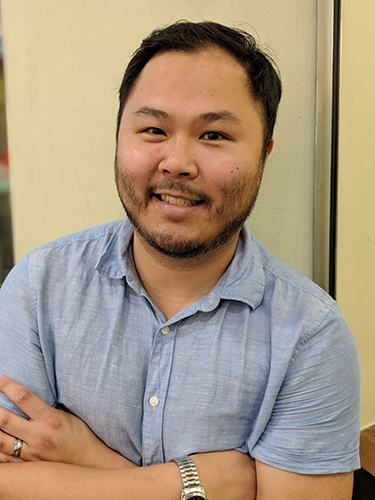
Dr. Jonathan Huang, an assistant professor in the Department of Public Health Sciences at the Thompson School of Social Work & Public Health, has been selected to lead one of four projects in the newly established Pacific Center of Artificial Intelligence and Data Science in Medicine (PAC-AID).
Huang will serve as the principal investigator on a five-year project studying how per- and polyfluoroalkyl substances (PFAS), commonly known as “forever chemicals,” affect placental function and child development.
“Forever chemicals are of particular concern to Hawaiʻi due to the variety of locally-relevant exposure sources, including agricultural and automotive run-off, food packaging, and even ocean spray. While there is ample evidence correlating PFAS exposures in pregnancy with child outcomes, the biological links are not clear and often limited to animal studies. Importantly, moms across the Pacific and Asia experience higher rates of pregnancy complications such as gestational diabetes that may exacerbate effects of PFAS and other environmental contaminants,” said Huang.
The project will develop machine learning methods that improve on our ability to leverage existing and emerging big data resources to understand how environmental chemical exposures affect child development, and especially how various populations may be affected differently.
PAC-AID was established through a $12 million award from the National Institutes of Health COBRE program to advance artificial intelligence and machine learning in medicine and biomedical research.
“Given the very relevant concerns around AI, including environmental impacts, it’s important that any work that leverages such resources provides a net benefit to communities. We’re very excited that PAC-AID focuses on using these resources to support and build capacity for improving the health of Hawaiʻi, the Pacific, and beyond. For our part, we are building ML tools to help improve researchers’ ability to use existing data and provide more actionable results. This is critical in Hawaiʻi and the Pacific given the relatively few existing studies that are centered on or relevant for our communities,” said Huang.
Learn more about PAC-AID: https://www.hawaii.edu/news/2026/06/21/12-million-establishes-pac-aid/